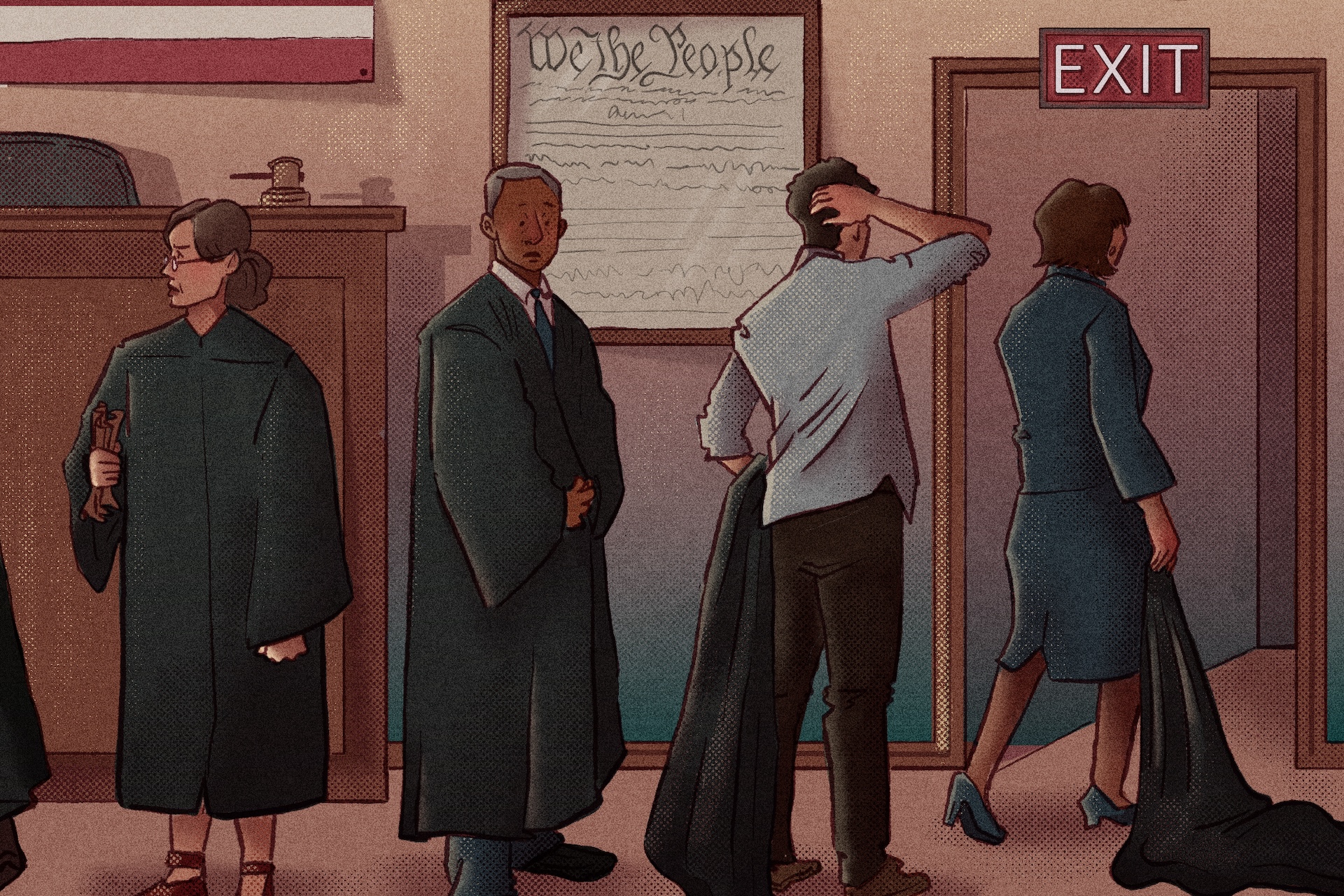
 Illustration by Kailey Ryan for Borderless Magazine
 Immigration judges are Justice Department employees. The Trump administration is using that system to fire judges, set new priorities and reshape the court at an unprecedented scale.
Samuel Cole, a former immigration judge in Chicago, decided to leave the judicial robes behind after the Trump administration began urging judges to follow orders or else.
“If I wasn’t going to be an independent judge, I wasn’t going to be a judge,” Cole said.
Cole is one of several former immigration judges in Chicago and Boston who told Borderless they felt increasing pressure from President Donald Trump’s administration to deny immigrants bond, increase deportations and deny asylum applications. Some believe they lost their jobs for refusing to comply with the administration’s pressure.
Noticias que ponen el poder en el punto de mira y a las comunidades en el centro.
Suscríbase a nuestro boletín gratuito y reciba actualizaciones dos veces por semana.
The Executive Office for Immigration Review (EOIR) declined to respond to specific questions, but a Department of Justice (DOJ) spokesperson provided a statement saying, “The Justice Department is restoring integrity to our immigration system by hearing cases fairly, expeditiously, and uniformly, in accordance with the law.”
Since January 2025, the Trump administration has fired over 100 immigration judges y appointed at least 140 new judges, many of whom were military attorneys without immigration law experience. Unlike most federal courts in the U.S., immigration court operates within the executive branch rather than the judicial branch — leaving the court system subject to political tampering.
What’s different now is the scale of changes. In addition to purging an unprecedented number of immigration judges, the Trump administration has initiated thousands of new removal proceedings, expanded its use of expedited removal hearings y established strict case completion metrics.
A vulnerable court system
Civil, criminal and appellate courts within the judicial branch are independent from the country’s chief executive — the president — and his administration. Additionally, federal court judges typically have life tenure to protect them from political influence.
In immigration courts, on the other hand, the court prosecutor and the judge both report up to the executive branch: the prosecutor to the Department of Homeland Security (DHS) and the judge to the Department of Justice. Immigration judges also do not have the same employment protections as judges in other federal courts.
The distinction becomes especially important when the president or other officials in their administration have strong stances on immigration.
Trump and his top administration officials have called immigrants “animals,” claimed they are “poisoning the blood of our country” and promised to carry out “the largest deportation operation in American history."
While the DOJ called on judges last year to treat both immigrants and DHS prosecutors in court “in a neutral, unbiased, and impartial manner,” it also advertised open positions on the immigration court bench as for “deportation judges."
Without the independence inherent to judicial courts, immigration judges, who have always been subject to “political tinkering,” according to Cole, have now been forced to become instruments of these aims — and immigrants have paid the price.
Más información

Sheila McNulty, formerly the chief immigration judge overseeing all U.S. immigration courts, said that the courts’ placement within the executive branch is fundamental to their operation.
“It’s an administrative law court. It’s not a court that functions independently of any entity. It is dependent on what the Attorney General and the administration set forth,” McNulty said. “If you look at the actual job title for an immigration judge, they’re technically considered a Department of Justice attorney. They’re not technically called a judge in the sense of a judicial officer like you have in federal court.”
McNulty was among four top immigration officials Trump fired shortly after his inauguration on Jan. 20, 2025. Many more have since lost their jobs. The Trump administration has purged more than 100 immigration court judges so far.
Most of the fired judges were appointed under Democratic presidents, and many had worked as attorneys for immigrants and had asylum-granting rates higher than national averages, according to a New York Times analysis.
At least eight former judges have filed lawsuits alleging that the administration targeted them because of their gender, ethnicity or political leanings. Among them is Carla Espinoza, a former immigration judge in Chicago, who said that the long-standing vulnerability of immigration courts to executive whims is only just now becoming clear.
“There was this false sense of security” during previous administrations, Espinoza said.
“Certainly, different administrations changed priorities and sometimes the pace or the tone within the courts.” But the differences between past administrations, including “Trump 1.0” and other presidencies, were not that drastic, she continued.
“We’re only now seeing how truly exposed immigration courts are,” she said.

In the rush to remove judges, the DOJ also appears to have terminated two judges by mistake, believing they were probationary employees, according to a court brief filed by the Washington Litigation Group, which represents the judges. The group argues that the firings violate the Civil Service Reform Act, which protects millions of federal employees from discrimination and retaliation. In response, the Trump administration has argued that the CSRA violates the executive powers granted to the president under Article II of the Constitution.
‘These are not real judges’
Underlying the tensions between immigration judges and the president is the Executive Office of Immigration Review. Established by the Attorney General in 1983, the EOIR oversees both the immigration court system and the Board of Immigration Appeals, which reviews appeals of immigration judges’ decisions.
Although the Executive Office of Immigration Review does not directly dictate individual case outcomes, its impact on courtrooms is difficult to overstate. According to federal regulations, the EOIR can regulate case time frames and priority, assign cases and dockets to courts and judges, and evaluate the performance of immigration judges. DOJ leadership generally does not need to wait on Congress or higher courts to enact changes to the operation of immigration courts. They need only release a memo.
According to Karen Musalo, professor and chair in international law at the University of California, San Francisco, oversight by the DOJ and EOIR severely limits immigration judges’ ability to rule independently.
“The people above them who are their supervisors, who are their bosses in the so-called chain of command, are within the DOJ, are within the Executive Office of Immigration Review,” Musalo explained. “They are the ones who set policy and directives for the judges to follow, and that is so antithetical to our concept of independent judges. If you get in your head that these are not real judges, they are Justice Department employees, then all of this becomes a little bit clearer.”
Under the current Trump administration, the EOIR has issued a slew of policy memos outlining updated expectations to increase efficiency. A February 2025 memo restored policies from Trump’s first administration that required judges to complete asylum hearings within 180 days and urged judges not to grant continuances, a common mechanism that allows immigrants more time to find attorneys.
Una April 2025 memo pushed judges to “pretermit” more asylum cases, denying asylum requests without ever holding a hearing. Other memos warned judges they would be evaluated for issuing decisions that were “adjudicatory outliers” and imposed case-completion benchmarks, meaning judges whose decisions did not match the new administration’s priorities — both in terms of case outcomes and speed — could be reprimanded or worse.
Former immigration judge Cole said he was used to pushing back against time pressures imposed by previous presidential administrations. But he saw the writing on the wall early in 2025 when memoranda began to trickle down, pushing judges to adhere to the new administration’s priorities.
“One of them says, you’re fine here as long as you’re loyal to the policies of this administration. So that got me. I’m loyal to my oath,” Cole said. He now works as the senior supervising attorney and chief immigration litigation counsel for the American Civil Liberties Union of Illinois.
The entwined relationship between immigration court judges and DHS prosecutors became even more difficult to navigate in May last year. On May 20, 2025, Immigration and Customs Enforcement sent a memo to DHS prosecutors instructing them to file motions in immigration court to dismiss cases and to coordinate the timing of these motions with ICE so that agents could be present outside the courtrooms. Ten days later, the DOJ sent an email to immigration judges urging them to grant motions to dismiss. In Chicago, Los Angeles, Dallas, Las Vegas, Miami and Seattle, immigrants emerging from courtrooms where their cases had just been dismissed were detained and processed for expedited removal.
After receiving the DOJ email, former immigration judge George Pappas said he went immediately to the assistant chief immigration judge in Boston — where he worked — for clarification. He said the assistant chief told him to grant the motions to dismiss unless those government motions were defective.
“So here I am getting direct pressure from my assistant chief immigration judge to grant the motions to dismiss knowing that they’ll be arrested as soon as they walk out,” Pappas said. “Of course, I didn’t grant a single one.”
Pappas said he was notified of his termination less than a month later.
Since McNulty, Espinoza, Pappas and over 100 other immigration judges were fired last year, many of the immigration judges who remained on the bench — as well as those hired by the Trump administration to fill new vacancies — have acquiesced to the pressure. The asylum-granting rate decreased by nearly half from August 2024 to August 2025, according to federal data analyzed by Transactional Records Access Clearinghouse.
More appeals than ever
The Board of Immigration Appeals sits above the country’s 73 immigration courts and reviews immigration court decisions that are challenged by immigrants or the government. Like immigration courts, the board exists within the DOJ, and its judges are lawyers hired by the U.S. Attorney General.
“So they have the same inherent pressures that we have to deal with, the same problem,” explained Pappas.
The majority of board decisions affect only the individual case brought before the board. Other board rulings are precedential, establishing rules that judges are supposed to follow when deciding cases with similar facts. These precedents apply to immigration courts nationwide and become binding.
Immigrants or their representatives can file lawsuits in a federal circuit court of appeals challenging either type of board decision, thereby moving the case out of the executive branch and into the judicial branch.
But unless immigrants go through this lengthy and expensive appeals process, their cases remain situated within the executive branch and subject to the political pressures that come with it.
“Imagine if you’re a detainee or you’re a person working a minimum wage job with a family and you want to exercise your rights and you want to pursue relief,” said Espinoza. “But then you have to be involved in not only the proceedings before the immigration court, then an appeal, and then finally a petition for review before a Circuit Court of Appeals. It’s a big legal undertaking, and so the ability for a lot of individuals to pursue those appeals is curtailed.”
In February 2025, then-Attorney General Pam Bondi reduced the immigration appeals board from 28 to 15 miembros permanentes. All Biden appointees were forced out, and the current board consists almost entirely of members appointed by attorneys general under either the first or second Trump administrations.
“In the last year and three months since Trump took over, the pattern has been to just ram a whole lot of decisions, denying a lot of cases, overturning precedential decisions, definitely overturning years and years and years of case law,” said McNulty.
Musalo said that politicization of the Board of Immigration Appeals is nothing new. Prior to the second Trump administration, the most radical restructuring of the board occurred in the years immediately following the Sept.11 attacks in 2001, when border control and immigration enforcement became permanent fixtures of national security.
In 2002, George W. Bush-appointee Attorney General John Ashcroft reduced the size of the appeals board from 19 to 11 by firing judges seen as pro-immigrant. Ashcroft also made it possible for a single member, rather than a panel of three, to decide a case.
Like changes made during the second Trump administration, many of Ashcroft’s reforms were challenged in court but largely remained intact, though attorneys general over the next 22 years gradually increased the number of board members. In the four years immediately following Ashcroft’s 2002 reforms, the Board of Immigration Appeals’ decisions favoring immigrants decreased by half.
The percentage of board decisions favoring DHS ranged from 45% to 75% during the Obama and Biden years, but in the first year of Trump’s second term, 97% of decisions ruled against immigrants in favor of DHS. The board also issued 70 precedential decisions in 2025, the highest since 2009, meaning Trump administration policy will govern the board’s decisions long after he has left office.
A DOJ spokesperson said, “The Board of Immigration Appeals decisions reflect straightforward interpretations of clear statutory language. President Trump and the Department of Justice will continue to enforce the law as it is written to defend and protect the safety and security of the American people.”
In the meantime, more immigrants than ever are appealing their cases to the Board of Immigration Appeals, with 99,603 cases appealed in 2025, nearly double the cases appealed the year before.
Espinoza, who now practices as an immigration attorney, said that many immigrants’ only recourse will be to file petitions for review of the board’s decisions in the hopes that they will be taken up by the federal circuit court.
“Now that the board is what it is, you have to go that extra mile,” she said. “It’s expensive and takes a lot of time, but up until that point, you’re stuck within a rigged system.”
Molly A. Wallace is a graduate student in journalism with Northwestern University’s Medill School of Journalism. This story was produced as part of a collaboration between Borderless Magazine and the Medill Investigative Lab-Chicago.