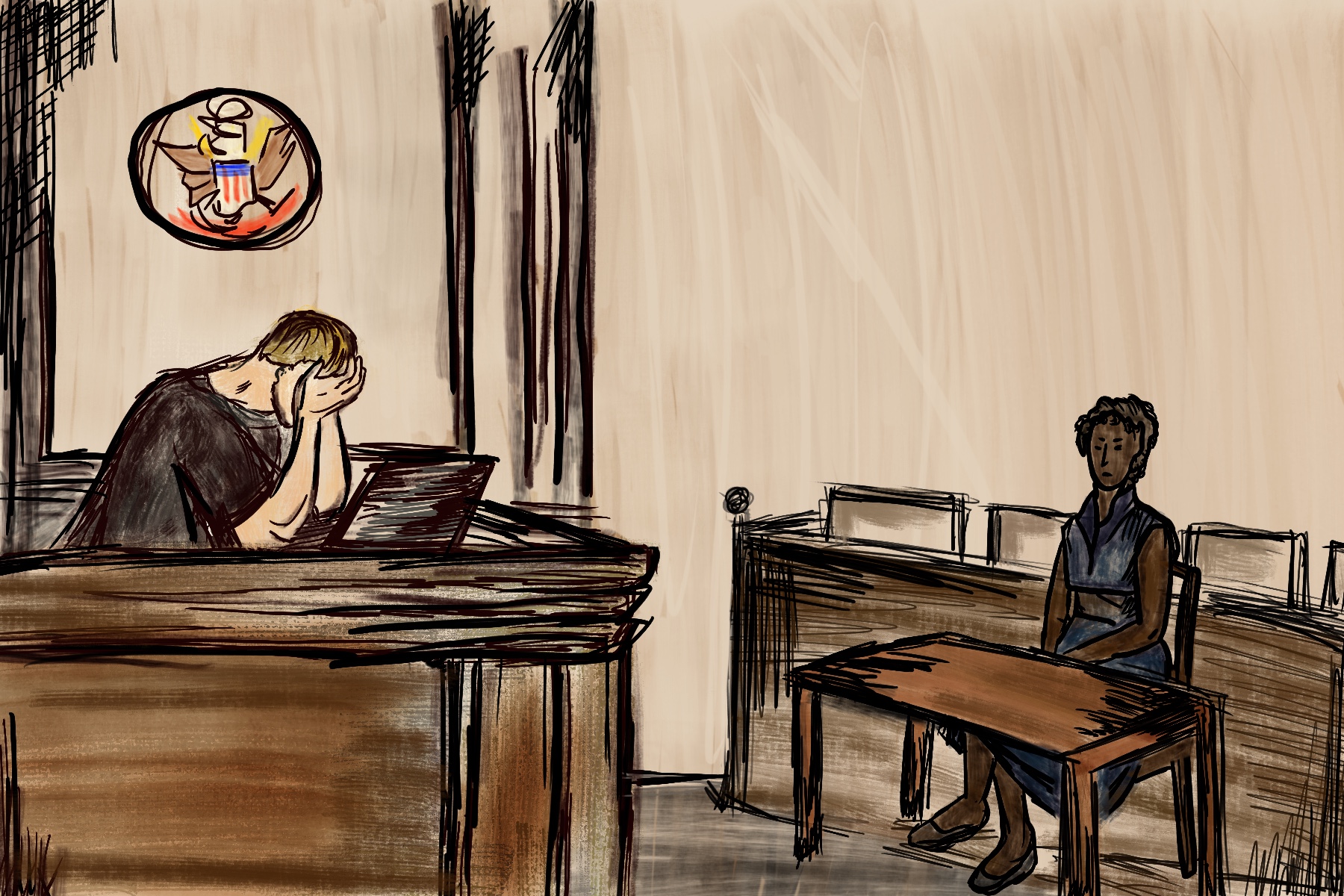
 Illustration by Grace Herzog for Medill School of Journalism/Borderless Magazine
From mistranslated words to unavailable interpreters, language barriers can undermine immigrants’ cases — affecting whether or not they stay in the U.S.
For nearly four years, she had shown up to hearings and check-ins that dragged on without resolution. Now it came down to convincing an immigration judge that her life would be in danger if she returned to Colombia.
When the woman finally took the stand in Immigration Judge Peter A. Kim’s Chicago courtroom, she spoke only in Spanish, pausing after each sentence as an interpreter relayed her words in English. She described being threatened and assaulted by a member of the National Liberation Army (ELN), a guerrilla group in Colombia designated by the U.S. government as a terrorist organization.
“What kind of weapon did they use?” her attorney asked in English.
The woman leaned into the microphone and said in Spanish, “Un arma.”
“A weapon,” said the interpreter, a native Spanish speaker from Mexico, not Colombia.
Her attorney asked her to specify. The woman used the same word; her only addition was the word “pequeña.”
“A small weapon,” said the interpreter.
The judge interrupted, asking, “Ma’am, can you just tell me what he was threatening you with?”
The woman, visibly confused, repeated herself with the same Spanish words. This time, the interpreter said “a small gun, a pistol.”
News that puts power under the spotlight and communities at the center.
Sign up for our free newsletter and get updates twice a week.
Later, in the hearing’s closing arguments, the Department of Homeland Security attorney cited the woman’s apparent hesitancy to identify the type of weapon as proof that she was inconsistent in her story and, therefore, not credible enough to be granted asylum. Her attorney pushed back, noting that “arma” is commonly understood in Spanish to mean firearm. The judge asked for further time to make a final decision about the woman’s asylum status, sending her back into the same limbo she had spent the last four years trying to leave.
Immigration court runs on interpretation, and all too often the process doesn’t go smoothly.
The vast majority of people who move through the system speak little or no English, making interpreters essential to ensuring that what asylum seekers say — and what they hear — is accurately understood by judges and lawyers.
In most immigration court hearings, the interpreter is not in the room at all. Instead, they appear on a screen via WebEx, a video conferencing platform, and are sometimes hundreds of miles away. Often, their cameras are off, or they dial in via an audio service, so the immigrants who trust them to convey their stories never see their interpreters’ faces.
While most hearings Borderless observed over the course of five months had adequate interpretations, mishaps like the one in Judge Kim’s courtroom can introduce critical misunderstandings that erode an asylum seeker’s credibility or otherwise interfere with an immigrant’s ability to plead their case. The problem may be structural: nearly all immigration court interpreters work as freelancers through large corporations that have contracts with the federal government. Some interpreters tell Borderless that this arrangement has led to frustration over low and late pay, which has driven experienced professionals out of immigration courts.
“Interpretation errors can really go and skew the credibility of a person,” said Alfredo Estrada, an immigration attorney and founding partner of the Immigration Law Center at Burke Costanza & Carberry LLP in Northwest Indiana. “If their story is not making sense because of a translation issue, a judge might interpret them as, ‘Okay, they’re not telling the truth.’”
Language barriers start outside the courtroom
Hundreds of immigrants pass through Chicago’s immigration court daily, speaking languages that span continents — from Kichwa, an indigenous language common in Ecuador, to Somali, Mandarin and Albanian. According to the most recent Department of Justice data available, more than 85% of immigration court cases in 2018 were conducted in a language other than English.
Seeking asylum or other relief from deportation involves filling out multiple complicated forms, most of which are in English. Attorneys may guide immigrants through this process, but the majority of people going through immigration court in Illinois do not have attorneys representing them, according to data compiled by TRAC. Unlike in criminal court, immigration court does not have to provide immigrants with an attorney if they cannot afford one.
While the federal government is required to provide interpretation during actual court hearings, there are no requirements for interpretation services anywhere else. In Chicago, where the main immigration court sits on the 15th floor of a privately owned building, the language challenges often begin in the lobby.
Once one actually enters the court, almost every official they encounter speaks only English. At the front desk, where asylum applications are filed and questions about court operations are answered, staff and legal clerks who often help immigrants with forms and call cases from the waiting room are not required to speak another language, according to an employee of the court who spoke on background.
Read More of Our Coverage

Many rely on Google Translate and physical gestures to get by. If a respondent doesn’t recognize their own name called in an unfamiliar accent, they may not realize their case is being heard, leaving them vulnerable to a removal order issued in their absence.
“There’s no way for somebody who has a very valid case, but a very rare language, to fill out asylum forms,” said Elizabeth Gibson, the managing attorney at National Immigrant Justice Center. “They may just get stuck in limbo or be ordered removed before they have the chance to say their case, just because they can’t fill out the paperwork.”
After the hearing, the problems with language barriers don’t end. One day, a group of Spanish-speaking immigrants stood stranded by the elevator long after their hearings had ended. Nobody had told them which button to press to get back down, and they waited there until a security guard finally walked over and did it for them.
Interpretation can impede immigrants’ stories
The stakes of a language divide reach their peak when an immigrant sits before a judge. In most cases, immigrants do not speak directly to the judge. Instead, everything passes through an interpreter, who is responsible for conveying not just words but the nuances of a person’s story.
For a judge to grant asylum, they must find an immigrant’s story credible and decide that it meets specific legal requirements. Ultimately, the immigrant must convince the judge that they will face harm in their home country, based on their race, gender or membership in specific social groups.
In a case Borderless observed in April, a Jordanian immigrant who spoke only Arabic appeared before Judge Michelle Venci. He had submitted an asylum application with testimony in English that was entirely inconsistent, and he did not seem to be aware of the problem. His asylum application claimed that he was forced to get married to a man in Jordan, and consistently confused the pronouns for this alleged spouse, a mix-up that likely wouldn’t occur without language barriers. The man, without a lawyer, told the judge the whole story was false. Venci gave him 30 days to file a new testimony in Arabic.
In many ways, the interpreter is the one making the case for an immigrant, and the consequences of getting it wrong extend far beyond the courtroom. For many immigrants, a denied asylum claim means being returned to the very dangers they fled: violence, persecution, and, in some cases, death.
Immigration attorney Isabel Li said that court interpreters can often be blunt or cut down an immigrant’s detailed responses into a short reply, regardless of whether an attorney is present.
“How you use language — that matters a lot,” said Li, who is bilingual in English and Mandarin and based in Chicago. “If the interpretation cannot really convey that kind of feeling we want … if they’re not saying it the way my client actually says it, sometimes it would affect the judge’s feelings.”
Attorney Estrada had a client describe being kidnapped, but instead of using “kidnapped,” the interpreter used the word “taken,” he recalled. While this change in wording was not a direct error, Estrada, who is the child of immigrants from El Salvador and speaks Spanish conversationally, said errors like these can significantly impact whether a judge believes their story.
“You lose that effect of the speaker when one’s trying to advocate for himself through testimony, and then the translator is this monotone person who’s not giving that effect,” he said. “We wonder whether the judge is listening to the translation or is he listening to the speaker and the way he’s advocating through himself, through his voice and emotion.”
Lawyers can only correct an interpreter if they get something factually wrong, not if the interpreter’s tone is slightly off, according to Li. Jose Goytia, an immigration attorney based in Chicago with native fluency in Spanish, said he asks his clients the same question in different ways, hoping their intent will come across to the judge more clearly.
The majority of Li’s clients are from China, a country home to hundreds of dialects varying across regions. An interpreter working with an immigrant who speaks a different dialect may have difficulty understanding and interpreting the immigrant’s accent and words. For example, she said that an interpreter from Southern China would struggle to interpret for someone from the North.

In Spanish, the most common language spoken by immigrants in court, immigrants often use local colloquialisms to tell their story. Goytia said that the meanings of these phrases in Spanish can vary dramatically depending on the country or even city the speaker is from.
One active Chicago immigration court interpreter, who speaks fluent Spanish and asked that her name not be used for privacy reasons, told Borderless she frequently runs into colloquialisms on the job.
She recalled one hearing in which a respondent said a phrase she knew meant one thing from growing up in Mexico. However, she knew the phrase had a different meaning in Venezuela, the immigrant’s home country. She chose to interpret the response in English, following the more common Venezuelan interpretation.
Additionally, immigrants’ access to education affects interpretation. Most of Li’s clients lack formal education, so they do not speak Mandarin as eloquently as the interpreter. This discrepancy, Li said, affects how their story comes across to the judge, as it can make them seem blunt or unsympathetic.
Small errors or an incorrect tone in court interpretation can have further ramifications when an immigrant appeals an asylum denial to the Board of Immigration Appeals. Unlike appeals based on improper proceedings or asylum criteria, Li said that challenging a decision based on nuanced interpretation issues can be very difficult — especially if an immigrant doesn’t have an attorney.
“I just can’t imagine how they [immigrants without an attorney] would preserve any issue of interpretation, or really that matter, any procedural error or evidentiary error by the court,” in presenting an appeal to the board, Estrada said.
Dialect differences are an issue beyond establishing credibility with the judge; differences in regional languages can also hurt an immigrant’s ability to understand what is happening.
On April 1, Borderless observed a couple from India appear via WebEx before Judge Gina Reynolds for their initial hearing. The husband answered her questions through a Gujarati interpreter. When Reynolds addressed the wife, the woman stared back blankly.
The husband explained: his wife spoke Gamit, an indigenous language. Reynolds pressed the interpreter, who was participating invisibly through an audio link, to find a solution. There was none, the interpreter said. Gamit was merely a dialect of Gujarati, so there would be no Gamit-specific interpreter.
The wife sat through the rest of the hearing, apparently unable to understand the proceedings unfolding around her.
Larger players dominate interpretation services
When interpretation fails, an immigrant cannot hire an outside interpreter to assist them in court. Instead, the fate of their interpretation is often controlled by two private companies with federal contracts: SOSi and Lionbridge.
Over the course of four months of court reporting, Borderless found that SOSi dominates in-person and video-call interpretation, while Lionbridge accounts for phone-in interpretation at the Chicago immigration court.
Interpreters working in certain fields must be certified by the government. At the federal level, the Court Interpreters Act of 1978 requires that courts use a certified interpreter in any civil or criminal cases initiated by the government. In most state courts, there is a certification requirement, but it varies from state to state. Specifically, Illinois circuit courts require interpreters to pass a state-wide certification program.
However, the federal government does not have a certification process or requirement for immigration court interpreters. While the federal government requires immigration court interpreters to take an oath stating they will interpret accurately, the companies that employ them set hiring and performance standards.
In February, SOSi announced it had been awarded an $875 million contract with the Department of Justice, of which the immigration court is a part. SOSi will continue to provide a range of interpretation services, including video remote services and in-person interpreters for immigration courts nationwide, as well as for other DOJ purposes, according to a SOSi press release.
It’s a deal that professionals like Alecsandrina Norman, who began working for SOSi in 2020 and is based in San Francisco, said creates a near monopoly on interpretation services in immigration court. Without competition, pay becomes low, she says, and experienced interpreters have more incentive to work in better-paying sectors.
Nick Boline, a Spanish-English interpreter and the vice president of membership for the Chicago Area Translators and Interpreters Association, noted that the low pay for immigration court work also deters interpreters from entering the field.
Boline started the certification process to become an immigration court interpreter with SOSi; however, he decided not to finish it. He said the pay rate for SOSi was lower than for other interpretation gigs, and he heard some interpreters had issues getting paid on time.
Indeed, Norman encountered payment challenges when working for the company.
Norman, who interprets from Romanian to English, said she received a 2% pay raise annually and earned $58 per hour in immigration court — roughly half the $115 per hour she would make in other legal courts.
Late payments added to her frustration. SOSi promises to pay interpreters within 30 days, but Norman said the company routinely misses that deadline. Additionally, in her contract, Norman was granted a $30 stipend to cover tolls and parking for courthouse appearances, but she said that amount was sometimes deducted from her pay without explanation.
When her contract expired in April, Norman decided not to renew.
She said she was not alone in the decision to move away from SOSi. She said that other immigration court interpreters she knew were trying to “not keep all your eggs in [one] basket” with SOSi.
“Sure, they’ll pick somebody else for cheaper, fine. But one day, you’re not gonna have somebody,” she said.
A way forward for interpretation
Over four months of reporting in immigration court in the winter and spring of 2026, Borderless observed numerous interpretation errors. From a phone-in interpreter confusing “yes” and “no” in Arabic to a Haitian Creole interpreter breaking up over the phone, interpretation issues can prevent an immigrant from having a fair hearing.
The interpretation errors Li has experienced led her to consider other ways interpretation could be offered in court.
Rather than requiring immigrants to use the interpreters provided, Li proposed allowing them and their attorneys to hire their own interpreters. In interviews with the U.S. Citizenship and Immigration Services (USCIS) — which processes asylum and other applications, such as Green Cards and refugee applications — applicants are required to bring a private interpreter, and a monitor is online to ensure the interpretation is accurate.
While this adds some cost for immigrants, Li thinks offering the option to bring one’s own interpreter would be beneficial in immigration court since having a private interpreter and a government monitor online creates a system of “checks and balances.”
Meanwhile, Estrada said attorneys can work around poor interpretation or inaccurate tone by being less deferential to DHS attorneys and judges.
“[Immigration attorneys] could brush up on the proper objections to be made, and to step up their game and advocate for their clients in a more, I wouldn’t say aggressive, but in a manner that puts pressure on DHS to do a proper job,” Estrada said.
Boline also said that paying interpreters more would help retain skilled interpreters.
“There’s not a labor shortage, there’s a wage shortage,” he said. “I don’t think there’s a shortage of competent, intelligent people who would love to get paid to interpret.”
Regardless of the obstacles, interpreters are still essential for immigrants’ stories to be told, heard and fully understood.
After his first hearing in court, an immigrant from Kyrgyzstan sat in Immigration Judge Brendan Curran’s gallery, attempting to fill out a change-of-address form. While he spoke only Russian and Kyrgyz, the form was entirely in English.
The Russian-English interpreter, who had just finished her final case, got up to leave the room. However, when she noticed him struggling, she crouched beside him and whispered instructions in Russian. After she went through the entire form with him, she stood up, smiled and walked out the door.
From procedural forms to testifying about why they left their home country, whether an immigrant’s story is understood coherently – and whether they understand the proceedings – can make the difference between staying in the U.S. and being removed from the country.
“All I want is for the client to get their story [across] as they said it,” said Goytia.
Grace Herzog is a junior studying journalism, political science and Asian American studies at Northwestern University.
Sarah Serota is a rising senior majoring in journalism and economics, with a minor in legal studies at Northwestern University.
This story was produced as part of a collaboration between Borderless Magazine and the Medill Investigative Lab-Chicago.