 Camilla Forte/Borderless Magazine/ Catchlight Local/ Report for America
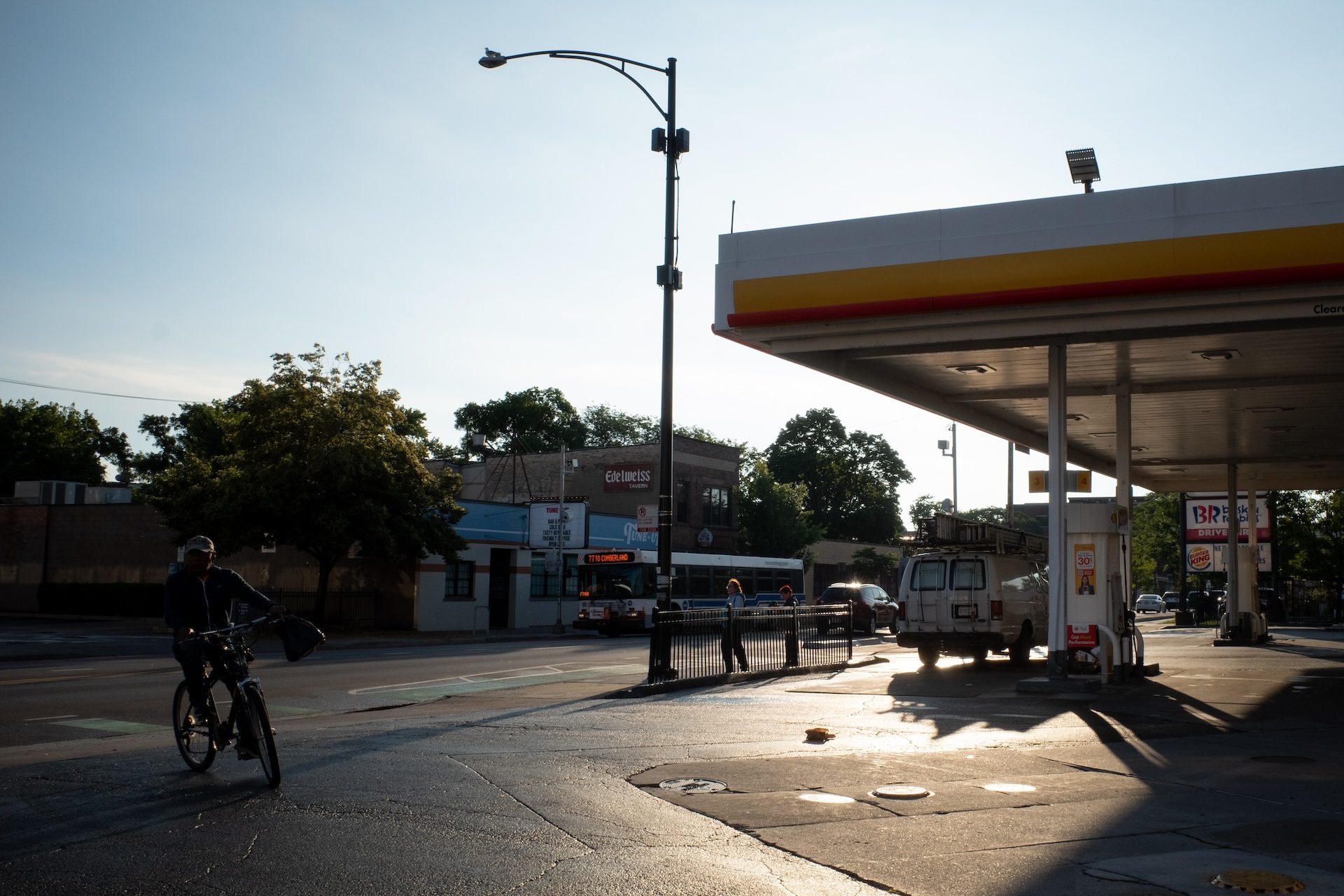
At a Shell gas station that has drawn day laborers for decades, immigration raids have scared off both workers and the contractors who hire them, prompting a network of volunteers to offer support and a sense of safety.
Editor’s note[07/02]: Borderless Magazine has chosen not to publish some of the interviewees’ full names to protect their safety and privacy. For questions, please contact us at [email protected].
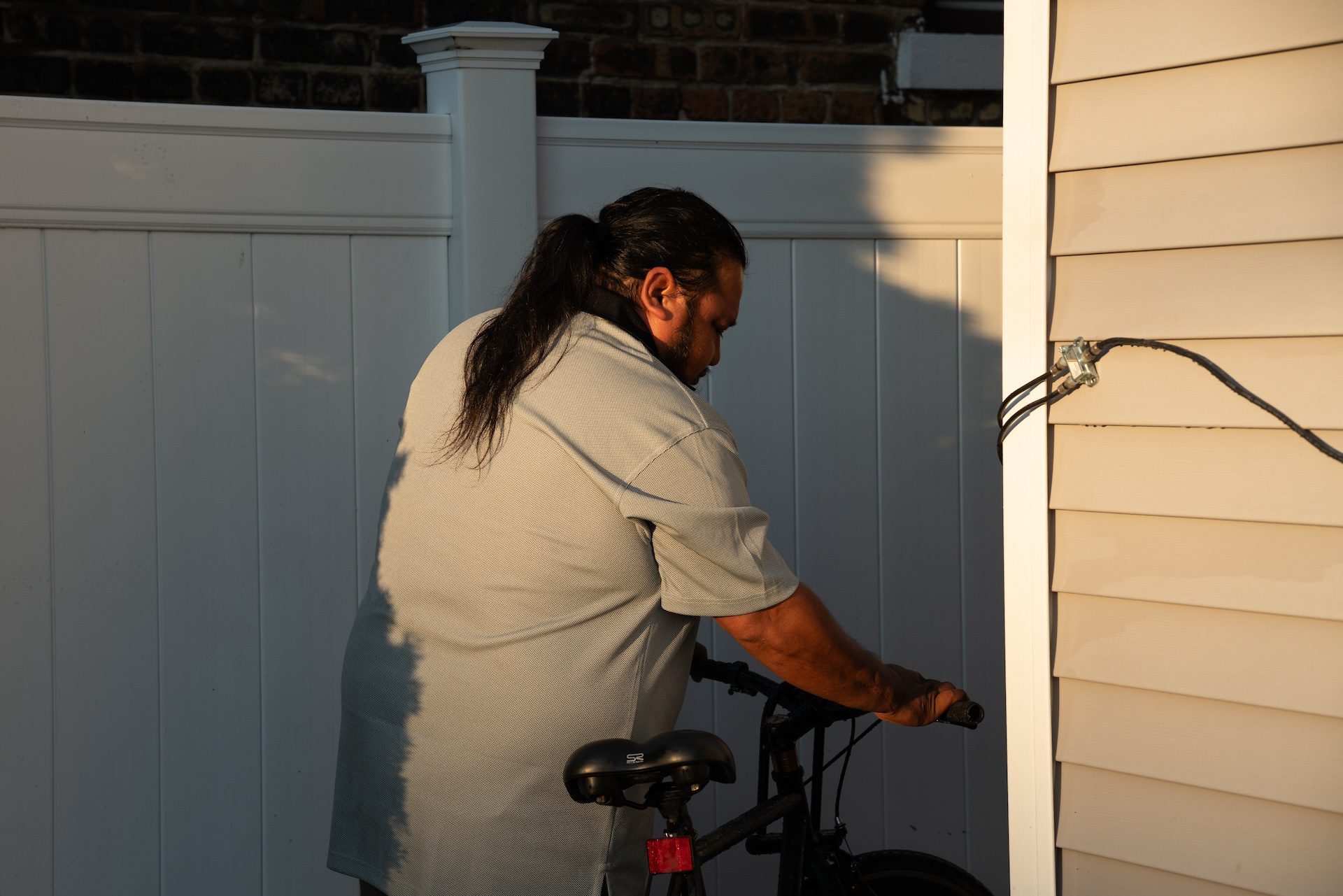
Almost every morning, Gualberto Olac unlocks his bike and pedals toward the corner of Belmont and Milwaukee Avenues. It is the same corner in Avondale he’s been visiting for over two decades, since he was 17.
Perched on a curb outside a Shell gas station and shaded by sunglasses and a sun hat, Olac, a Mexican immigrant, glances around the lot, eyeing every passing car. Across from him, another man with a backpack and a blue baseball cap does the same, switching between sitting and standing as he watches cars drive by.
In years prior, the scene at the station was very different. Every morning, hundreds of immigrants used to gather there. The Shell gas station has served as one of the oldest informal hiring spots for Chicago’s day laborers. General contractors and others looking for an extra set of hands would stop by, negotiate wages and take willing workers with them to work for a few hours before dropping them off at the station later.
News that puts power under the spotlight and communities at the center.
Sign up for our free newsletter and get updates twice a week.
This year, only about a dozen or fewer people have been waiting for work at the site at a time.
Olac remembers watching for trucks offering day jobs in roofing, painting, dishwashing or moving furniture. If he was lucky, he would get picked up for a second job at the same site after finishing a gig in the morning. But in the last year, that’s changed.
Since Operation Midway Blitz, the number of day laborers showing up for work had already significantly declined, and so had the number of people coming by the corner to offer them work. Several day laborers told Borderless the number of people seeking work has diminished because potential encounters with immigration enforcement have scared off other day laborers. They also noticed fewer people seeking workers at the site than they used to. That often means day laborers wait longer to get a job on a given day, if they get one at all.
The number of workers is dwindling further as local police crack down on day laborers seeking work at the site. Chicago police arrested three men looking for work at the site in late June, several day laborers told Borderless.
Day laborers say the threat of arrest by police, on top of the risk of detention by immigration agents, makes it difficult to find work and make ends meet.
ICE raids upend day labor corners
Olac knows the risk of being detained while looking for work firsthand. About 10 years ago, federal immigration agents detained him and another day laborer looking for work at the same Shell gas station, Olac told Borderless. After his release, he kept returning to the corner but remained cautious, not immediately approaching unfamiliar cars.
That caution has served him well in the last year.
Immigration enforcement under President Donald Trump’s administration targeted day laborer sites for several raids last year, with dozens of laborers being detained by agents, according to reporting by the Chicago Tribune.
Efforts by the Trump administration “thrust day laborers back into the public consciousness and, of course, put them in the line of fire for immigration raids,” said Nick Theodore, a professor of urban planning and policy and director of the Center for Urban Economic Development at the University of Illinois Chicago.
Theodore says that while day laborers are mostly newly-arrived immigrants looking for a foothold in the local economy, his research shows this is not always the case. Regular construction workers who navigate the ups and downs of the industry make up at least an equal share of day laborers. Meanwhile, during economic downturns, workers displaced from other industries become day laborers as they seek to replace lost income.
The targeting of immigrant day laborers by ICE has had ripple effects across the day laborer workforce, Theodore said. It has left day laborers more vulnerable to exploitation, made some afraid to seek work at hiring sites and made employers afraid to pick workers up at all.
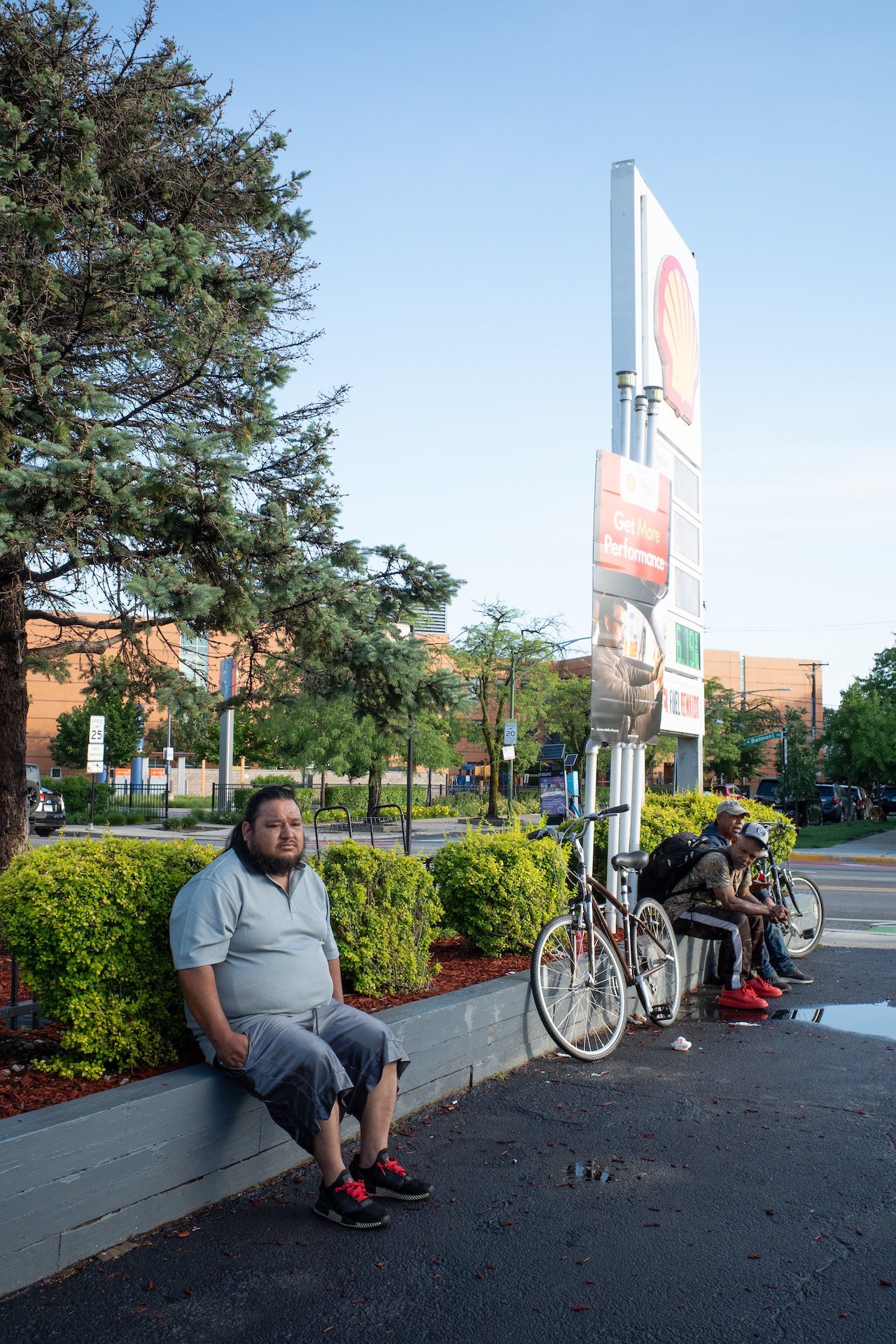
Mario, a Honduran immigrant, saw two of his friends get detained by ICE agents at the Shell gas station in October of last year. He said both are in Honduras now.
Still, he needs money. He said he returns to the site almost every day, even though it’s becoming harder and harder to find work there.
Mario said he understands there is a risk of being taken into ICE custody even though he has a Green Card. He said he wouldn’t be able to prove his immigration status immediately if detained, because he lost his Green Card along with other documents, including his Social Security card and driver’s license.
Still, the risk of getting detained doesn’t deter him.
“You have to walk by the hand of God, because you have no other option,” he said.
Fewer workers, fewer jobs
Esteban and his wife show up at the corner almost every day. They often have to wait only briefly before getting into a car and heading straight to work.
But recently, his stop by the corner took an unexpected turn. Esteban and two other day laborers were arrested by police on Wednesday, June 24, 2026.
The week prior to the arrests, Olac said police had stopped by the corner, telling him and other day laborers to leave the gas station and warning them that if they came back again, they could be arrested.
The Chicago Police Department’s Office of Communications confirmed officers responded to multiple complaint calls at 3100 N. Milwaukee Ave. over the last two weeks and made several arrests.
Read More of Our Coverage
The increased police presence has become an added barrier for day laborers at the site, who had already been struggling to find work more regularly since Operation Midway Blitz.
“Some days it works out, and some days it doesn’t,” said Gudiel Perez, a Guatemalan immigrant and day laborer at the site.
Perez used to be able to get two jobs for a couple of hours each day, maybe even a third one if he was lucky. Now, he gets picked up on average about twice a week.
“You can’t even make enough to eat,” said Perez.
During Operation Midway Blitz, he went about three months without work.
In October of last year, federal immigration agents arrested five day laborers during a raid. Two were released after confirming their immigration status, several day laborers told Borderless.
Borderless Magazine was able to confirm the presence of CBP agents at the hiring site that day through photographic evidence and confirmed reports provided by neighborhood rapid responders.
In a written statement, CBP also confirmed that three men were arrested by border patrol agents on that day.
“They almost got me when a raid came,” said Perez, who was at the site that day.
Some day laborers are noticing a slight uptick in work opportunities at the site as temperatures warm and immigration arrests slow down since Operation Midway Blitz.
“Work has dropped a lot, but it is getting better,” said Carlos, who has been going to day laborer hiring sites on and off for about 10 years.
Still, ICE has maintained a presence in the Northwest Side as recently as June.
Building a safe space for workers
Organizations like the Latino Union of Chicago have stepped in to support day laborers during this time. Launched over 20 years ago, the labor organization serves low-income and immigrant day laborers, domestic workers and other contracted workers. Their work involves supporting members in wage theft, abuses by employers and immigration cases through education and by helping them file complaints of abuse to the Illinois Department of Labor.
Last October, the Latino Union decided to do more to support day laborers facing possible ICE activities while waiting for work. Volunteers began setting up designated safe spaces for day laborers to gather and seek work, serving as rapid responders and distributing resources.
The idea to set protections in place for day laborers, called Adopt-a-Corner, came after targeted abuses were reported at a Home Depot parking lot on 47th and Western.
At the hiring corner at the Shell gas station, a volunteer or two from the Latino Union show up on Friday mornings with coffee, snacks and Know Your Rights materials to distribute to day laborers while they wait for work. Currently, the initiative comprises about five sites across Chicago, with about 20 volunteers in the neighborhoods where the hiring sites are located.
“We have people who live in that neighborhood manage that corner, manage the scheduling, who’s going to show up, if there are needs, how to find [and] meet those needs,” said Geovanni Celaya, migrant worker organizer at the Latino Union of Chicago.
The volunteers also offer assistance with food or Ventra cards.
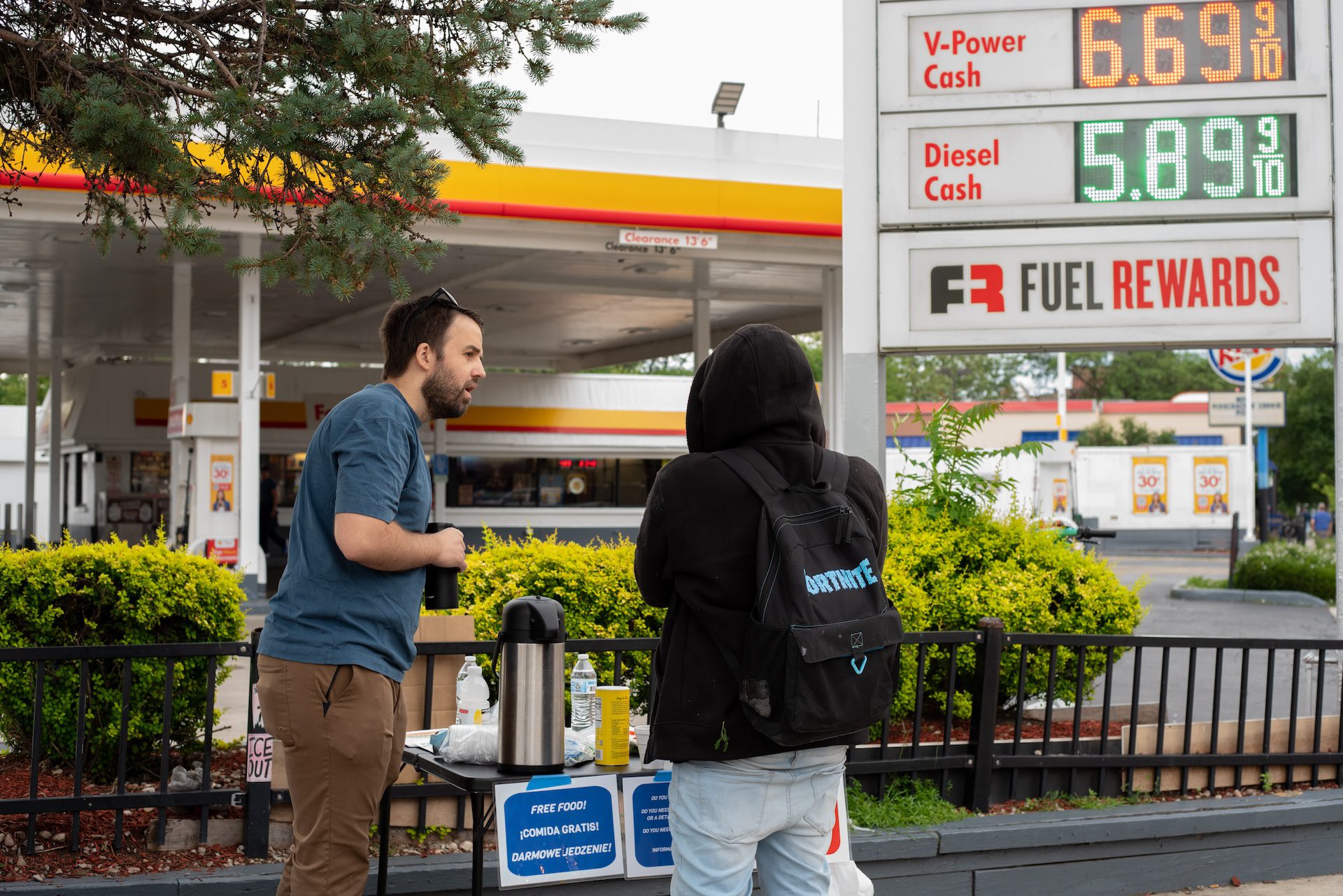
The purpose of the Adopt-a-Corner program, said Celaya, is to give day laborers a sense of security. The group hopes to have enough volunteers to have someone at each site most days from 6 a.m. to 2 p.m., the times day laborers are usually at sites looking for work, said Alex, one of the volunteers who goes to the Shell gas station on Fridays.
“Day laborers especially have always been a particularly vulnerable population, and I think it’s important that people also realize that they’ve suffered harassment and sort of racist abuse from police and from community members before even these latest immigration raids,” said Alex.
Felisa Erway is a consistent volunteer at the site almost every Friday. Learning about how day laborers had been affected by heightened immigration enforcement motivated Erway to seek volunteer opportunities in her neighborhood.
That’s pushed her to focus on relationship-building at the site, and to help day laborers know “they’re not being completely overlooked and unprotected,” said Erway.
Historically, communities impacted by injustice have felt isolated, and “acts of accompaniment” like the Adopt-a-Corner initiative can help them feel supported, UIC’s Theodore said.
“I think it is a powerful political statement that goes at the root of the isolation that affected communities might feel and says you’re not in this alone, we are here with you,” he added.
Humanizing the workforce
The Adopt-a-Corner initiative is a pilot program that the organization hopes can, in the future, be government-backed through a city ordinance.
“The idea is that the city becomes responsible for [protecting day laborers] and an agency…becomes the people who are there supporting wage theft and any other labor concerns that day laborers might have,” said organizer Celaya.
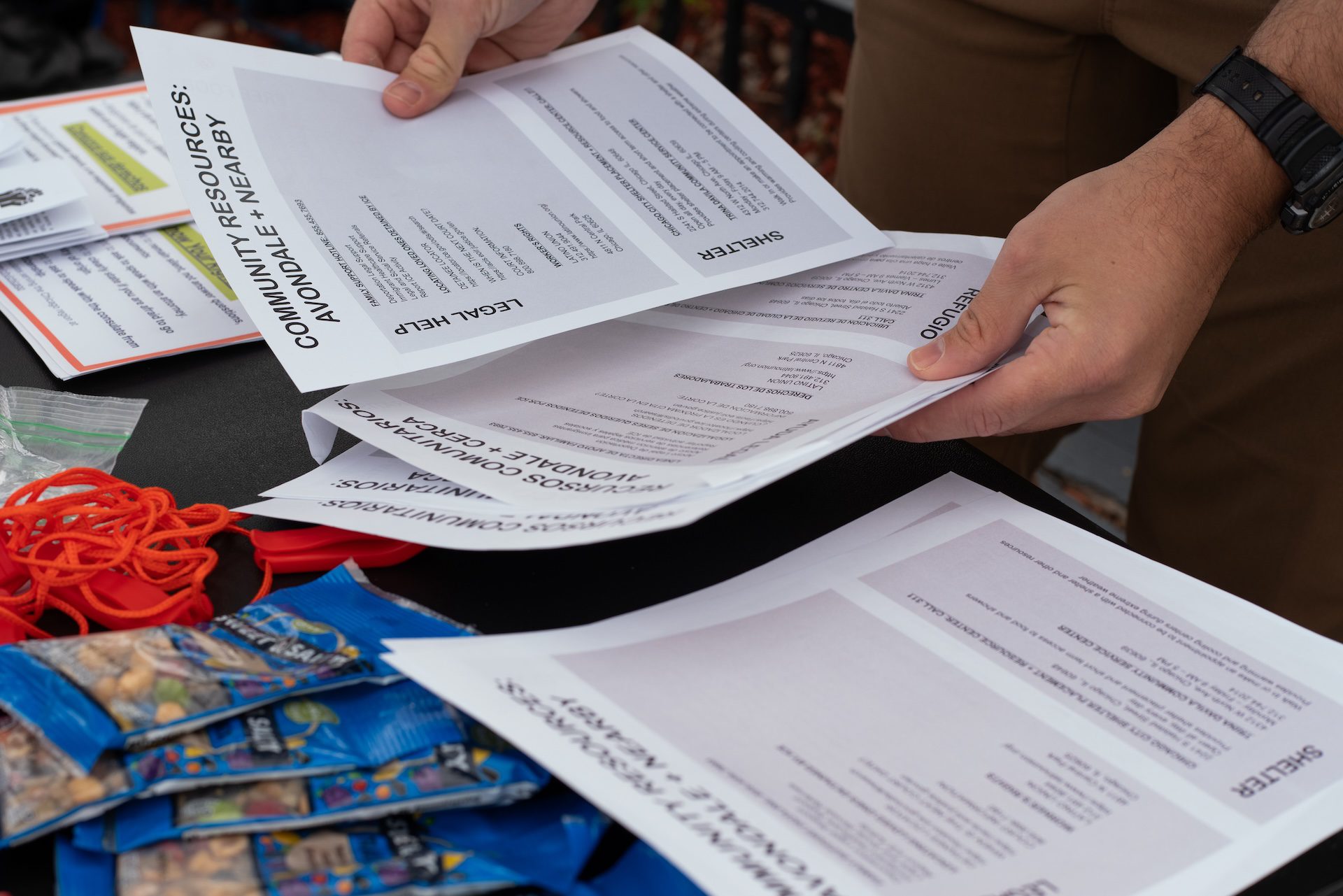
Chicago isn’t alone in community-led efforts to support day laborers. Other large cities also see similar scenes of immigrants looking for manual labor gigs, typically outside of home improvement stores.
The Day Labor Center in Plano, Texas, for example, has been around for more than 20 years. The Plano program operates at a central location, whereas the Latino Union’s version is decentralized, meeting day laborers where they already look for work rather than building a single fixed site. Similarly, Los Angeles offers city-supported hiring sites across the city where day laborers can safely congregate and look for work.
Theodore sees Adopt-a-Corner as part of a longer Chicago tradition comparable, he said, to the community-led efforts to receive Central American migrants sent to the city from Texas, calling both “examples of solidarity, of mutual aid, that all work to try to repair a very torn social fabric in the name of solidarity and of social justice.”
“With day laborers thrust back into the limelight, not by their own choosing, but by an administration that wants an immigration crackdown,” Theodore said. “I think what Adopt-a-Corner does is it helps humanize a workforce that so often has been demonized and misunderstood.”
Aydali Campa is a Report for America corps member and covers environmental justice and immigrant communities for Borderless Magazine. Email Aydali at [email protected].
Camilla Forte is a CatchLight fellow and Report for America Corps Member covering immigrant communities for Borderless Magazine. She can be reached at [email protected].