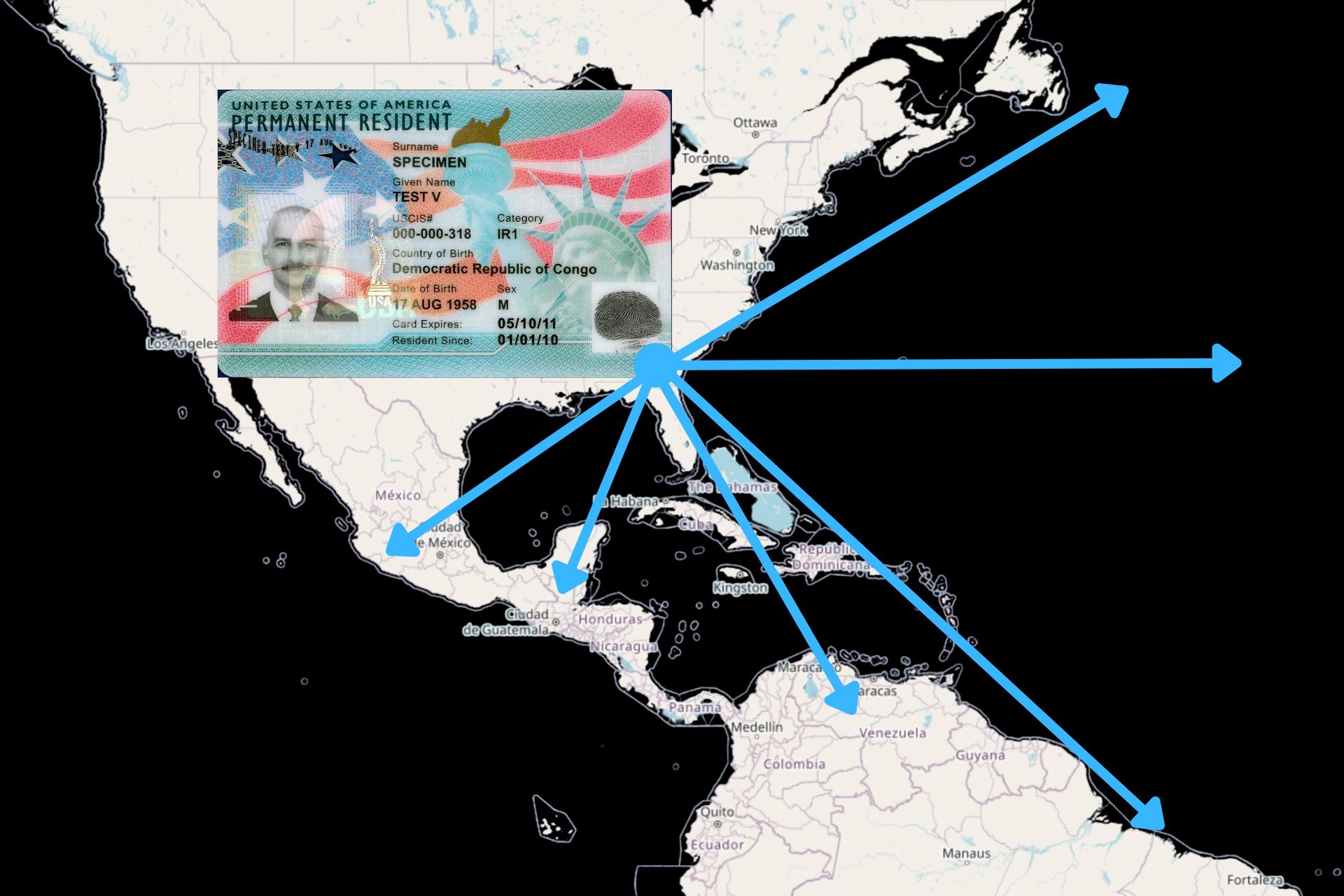
 Photo illustration by Max Herman/Borderless Magazine. Source images: Associated Press, OpenStreetMap, and Canva.
 A new USCIS memo may require thousands of immigrants to leave the U.S. before petitioning to apply for a Green Card. Borderless Magazine put together a guide about what you should know about the latest changes.
Some immigrants applying for a Green Card will be required to leave the United States to apply through a U.S. consulate abroad, according to a policy memo from the United States Citizenship and Immigration Services (USCIS).
The memo, issued late last month, says that individuals seeking lawful permanent residency must complete consular processing outside of the country, except in “extraordinary circumstances.”
The Department of Homeland Security later clarified that applicants will be assessed on a case-by-case basis.
The move comes as President Donald Trump’s administration works to impose further restrictions on legal immigration.
News that puts power under the spotlight and communities at the center.
Sign up for our free newsletter and get updates twice a week.
Federal officials say the aim is to prevent people from remaining in the U.S. after being denied permanent residency. Immigration law experts, however, warn that this could impact hundreds of thousands of Green Card applicants each year.
“This is a rewrite of what has been practiced for the last several years,” said Sharvari Dalal-Dheini, senior director for government relations at the American Immigration Lawyers Association (AILA), during an AILA press briefing last week.
Borderless Magazine put together a guide about what Green Card applicants need to know about the policy and its impact.
What is a Green Card, and who can apply?
A Green Card, also known as a Permanent Resident Card, allows the holder to live, travel and work in the U.S. indefinitely. It is widely known as a pathway to U.S. citizenship through naturalization.
Adjustment of status is a process established in 1952 that allows eligible individuals to apply for a Green Card when present in the United States, without needing to leave the country and apply through a consulate abroad.
A Green Card applicant must be eligible under one of these categories:
-
Family sponsorship,
-
Employment,
-
Special immigrant status,
-
Refugee or asylee status
-
Victims of human trafficking or crime
-
Or for victims of abuse.
What is the current process to apply for a Green Card?
The Green Card application process will vary depending on the applicant’s situation.
Generally, in order to complete the Green Card application process, an applicant must file an immigrant petition form, which consists of someone else sponsoring or petitioning for the applicant. Some applicants may be eligible to petition themselves.
Once this form is approved, they must file a Green Card application, also known as a Form I-485 to USCIS.
Next, the applicant undergoes a biometrics appointment and an interview before an officer makes a final decision on the petition.
Under the newly-released policy memo, applicants must prove they meet “extraordinary circumstances” to apply for a green card in the U.S.
Who is impacted under the new policy?
Experts say that it is unclear who will be impacted by the policy at this time.
Jeff Joseph, president of AILA, says it’s not clear whether this policy will apply to future applications immediately or retroactively.
Similarly, Dalal-Dheini also says that it’s unclear how strictly they will follow this policy, and who qualifies for exceptions.
Experts at the American Immigration Council say applicants who are immediate relatives of U.S. citizens or applicants from one of the 75 countries where consular processing is not currently available could be at a higher risk under the policy memo.
Dalal-Dheini also noted that redirecting cases to “already overburdened U.S. consulates” would create backlogs worldwide.
“Consulates have been gutted by the administration, and they are already struggling.”
What do experts recommend?
Joseph recommends that people maintain their underlying immigration status, if possible.
He also suggests that Green Card holders or applicants should meet with an immigration lawyer if they have any status violations like overstaying a visa.
Tara Mobasher is Borderless Magazine’s newsletter writer and reporter. Email Tara at [email protected]
Clarification 6/4/26: This story has been updated to clarify the Department of Homeland Security’s guidance to review how individuals should apply for a Green Card on a case-by-case basis.