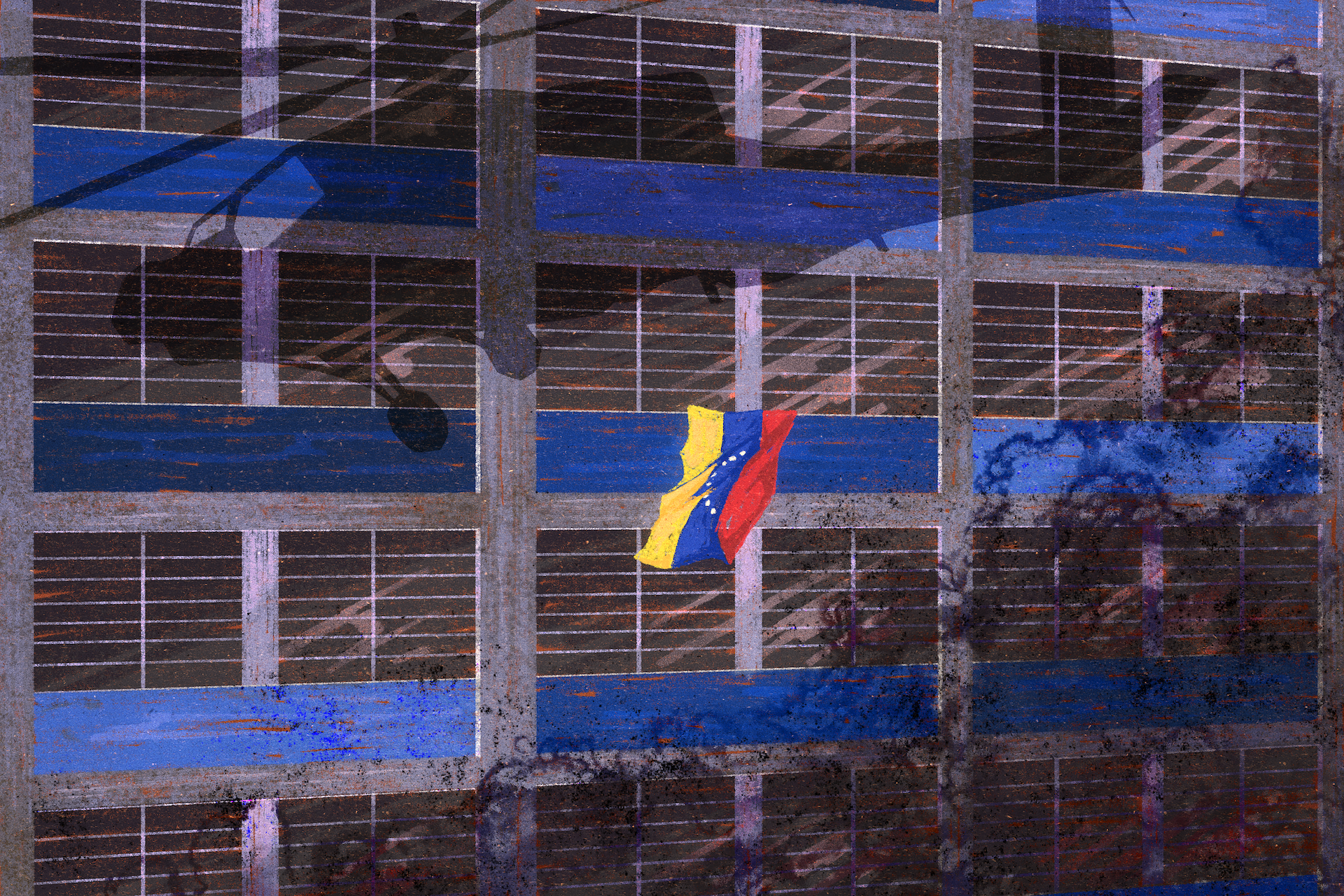
 Illustration by Jen Chavez for Borderless Magazine
 Fearing deportation in Chicago, a Venezuelan national returned to her home country, but Maduro’s capture made her once again uncertain about her future and safety.
This story was supported by the Brave of Us campaign.
Editor’s note[2/03]: Borderless Magazine has chosen not to publish the interviewee’s full name to protect the individual’s safety and privacy and use her first initial, R, for reference. For questions, please contact us at [email protected].
Venezuelan national, R, 62, and her son returned to her home country after her Temporary Protected Status (TPS) expired in November while living in Chicago.
To avoid deportation, they made a long journey back to Venezuela in December. Just three weeks later, Venezuela’s authoritarian leader Nicolás Maduro was captured and taken to the U.S.
News that puts power under the spotlight and communities at the center.
Sign up for our free newsletter and get updates twice a week.
Before leaving Venezuela, R was an activist who spoke out against Maduro’s regime.
Now, she no longer dares to do so.
Maduro’s regime continues to surveil residents at checkpoints throughout the country and monitor communication, especially of those who oppose his regime, she says.
Borderless Magazine spoke to R about what led her to return to Venezuela and her thoughts on Maduro’s capture.
Growing up in a different Venezuela
I was born in Venezuela, raised in Caracas in the 60s and 70s. I loved music and singing, so I left to study baroque music in Montreal, Canada. When I finished, I returned to my country. Back then, I was at peace in Venezuela. It was safe, so there was no need for me to leave.
Upon my return, I found a job, got married and had two kids.
Just two years after my second child was born, Hugo Chávez won the presidential election, and everything changed. The socioeconomic decline was notorious.
The government began seizing private properties. Inflation rose. Everything became expensive.
After I got a divorce, I could not afford a place of my own for my kids and me.
I worked at a publishing house and taught music and sang on the side to make ends meet.
Then the publishing house shut down, like many other businesses in Venezuela. I then worked at a book distributor, but it still was not enough, so my parents helped me buy an apartment for my family.
During this time — since Chávez took office — I consistently protested. At marches, the national guard would disperse protesters with tear gas bombs, pepper spray and water cannons.
In 2015, my children left. We were anxious about the immense insecurity they were seeing in Caracas. I encouraged them to leave Venezuela because I was always nervous about their safety.
My daughter left for Spain, and my son skipped his high school graduation and went to the U.S.
The following year, my friends in Miami encouraged me not to remain alone in Venezuela. Given how little I was making at my job, I realized it was no longer worth staying. So I left and made a series of trips, visiting friends and family in Florida, Illinois, Colombia and Spain on tourist visas, before eventually returning to Venezuela.
I used some of my savings, and my friends and children let me stay with them to avoid staying in Venezuela for extended periods.
In 2017, I returned home from this long trip to a time when protests were extremely violent and killed many people.
The country looked worse than it had just the year prior. You could see the hunger in the streets. Many people were surviving by eating out of garbage cans and mangoes from the trees. It was as if nature knew what was happening because we had a big harvest of mangoes on the trees in the city that year.
The deterioration of the people was alarming. People in the streets looked very thin. It was a horrible situation.
Finding independence in the U.S.
I didn’t consider leaving Venezuela permanently because I didn’t have anyone who could sponsor me for a visa to stay in the U.S. I didn’t have a long-term plan to stay in Spain either. I always planned on returning to Venezuela.
But, the whole country was deteriorating.
During one of my extended visits to see my friends and family, the pandemic started, and I was stuck in Miami. While I was there, my tourist visa and my Venezuelan passport expired. Since we didn’t have Venezuelan embassies or consulates in the U.S., I wasn’t able to get a new passport.
A lawyer I was in touch with called me and said there would be Temporary Protected Status (TPS) for Venezuelans. I applied and was granted it.
I was able to start working with this status, so I worked in childcare until I moved to Chicago in 2022, where my son was.
There, the Illinois Venezuelan Alliance helped me find a job at an immigrant support clinic, where I assisted people with completing their TPS and asylum paperwork.
I had the opportunity to meet migrants from Venezuela who arrived in Chicago in a deplorable state. Some didn’t even know how to hold a pencil to write their own name, and the children I met were in truly sad and painful situations.
In my job, I was in contact with many people in this field, and I learned a lot about various cases during the height of immigration enforcement action in Chicago last year. I learned about horrible cases of families being separated and the violent use of force by immigration agents.
I was terrified that ICE (United States Immigration and Customs Enforcement) would grab me, take me somewhere unknown, deport me, even though I still had a valid TPS. The whole situation scared me too much.
I had been at peace in Chicago. I was able to work. I was independent. But my work permit was ending and persecution began. So when my TPS expired, I decided to go back.
After eight years of living in the U.S., I had to give away all my belongings and plan my return to Venezuela.
The trip was expensive because, since sanctions against Venezuela began a few years ago, there have been no direct commercial flights between the United States and Venezuela.
I had to do a lot of logistical work to plan my trip back because Venezuelan nationals cannot fly into Venezuela with an expired passport.
So I ended up flying from Chicago to Bogotá, from Bogotá to the border. From there, I took a taxi into Venezuela, then flew to Caracas. It was a two-day journey.
My apartment looked just like when I had left it, thinking I’d be back soon.
Since Maduro’s capture
I always stayed informed about news from Venezuela, even during the eight years I was in the United States, so I knew an attack could happen at any moment.
At 2:00 a.m. on Jan. 3, I was still awake when I heard a super loud explosion and thought it was fireworks. I went out onto the balcony and immediately realized it wasn’t fireworks.
I immediately understood what was happening when I saw the helicopters from my balcony.
A couple of hours later, Trump announced that they had captured Nicolás Maduro. I heard shouts of joy, banged pots and pans, but that didn’t last long. A deathly silence followed.
There was absolutely no movement when dawn broke that day. The next day, I found out that one of the supermarkets nearby increased its prices. There was nothing on the highways or the more distant streets. Everyone was sheltering at home.
I don’t know if I’d dare to do as much activism as I did previously.
Now, people are more cautious. There are checkpoints everywhere to search people and go through their cell phones.
I don’t keep photos on my cellphone or show any sign of celebrating Maduro’s fall.
Basically, in Chicago, ICE was after us, and here, the government is after us, too. We’re always hiding.
For now, I’ll stay home and keep a low profile. I may find work teaching English or music.
I don’t expect things to improve soon or for the change to be very favorable. There’s going to be a lot of political tension. I don’t know exactly how things will unfold.
That’s something no one can know for sure: whether they’re truly paving the way for a transition and the return to the country the people of Venezuela demanded as president, so that we can return to a democratic country like we once were.
The interviewee’s words have been translated from Spanish by Aydali Campa.
Aydali Campa is a Report for America corps member and covers environmental justice and immigrant communities for Borderless Magazine. Email Aydali at [email protected].
This story was produced using Borderless Magazine’s collaborative as-told-to method. To learn how we make stories like these, check out our as-told-to visual explainer.