 Camilla Forte/Borderless Magazine/Catchlight Local/Report for America
From sanctuary efforts in the ‘80s to Trump’s latest deportation efforts, Chicago’s faith leaders lean into commitment to immigrants.
Sister JoAnn Persch and Sister Pat’s work began with finding a place for a few immigrants to stay, then a home for those fleeing torture in Central America. From then on, their support for new arrivals never wavered.
Recalling her efforts, Sister JoAnn, who passed away last month, explained to Borderless in the spring that what has kept her going for nearly five decades is the idea to “just do each day what you’ve been called to do, and you’ll be fine.”
Persch was a tireless veteran who, along with others, helped create a legacy of Chicago clergy stepping up to care for immigrants.
News that puts power under the spotlight and communities at the center.
Sign up for our free newsletter and get updates twice a week.
In recent months, there has been a surge of clergy nationwide stepping up to support immigrants, but in Chicago, the roots of this work run deep — decades before Trump’s crackdown on immigration.
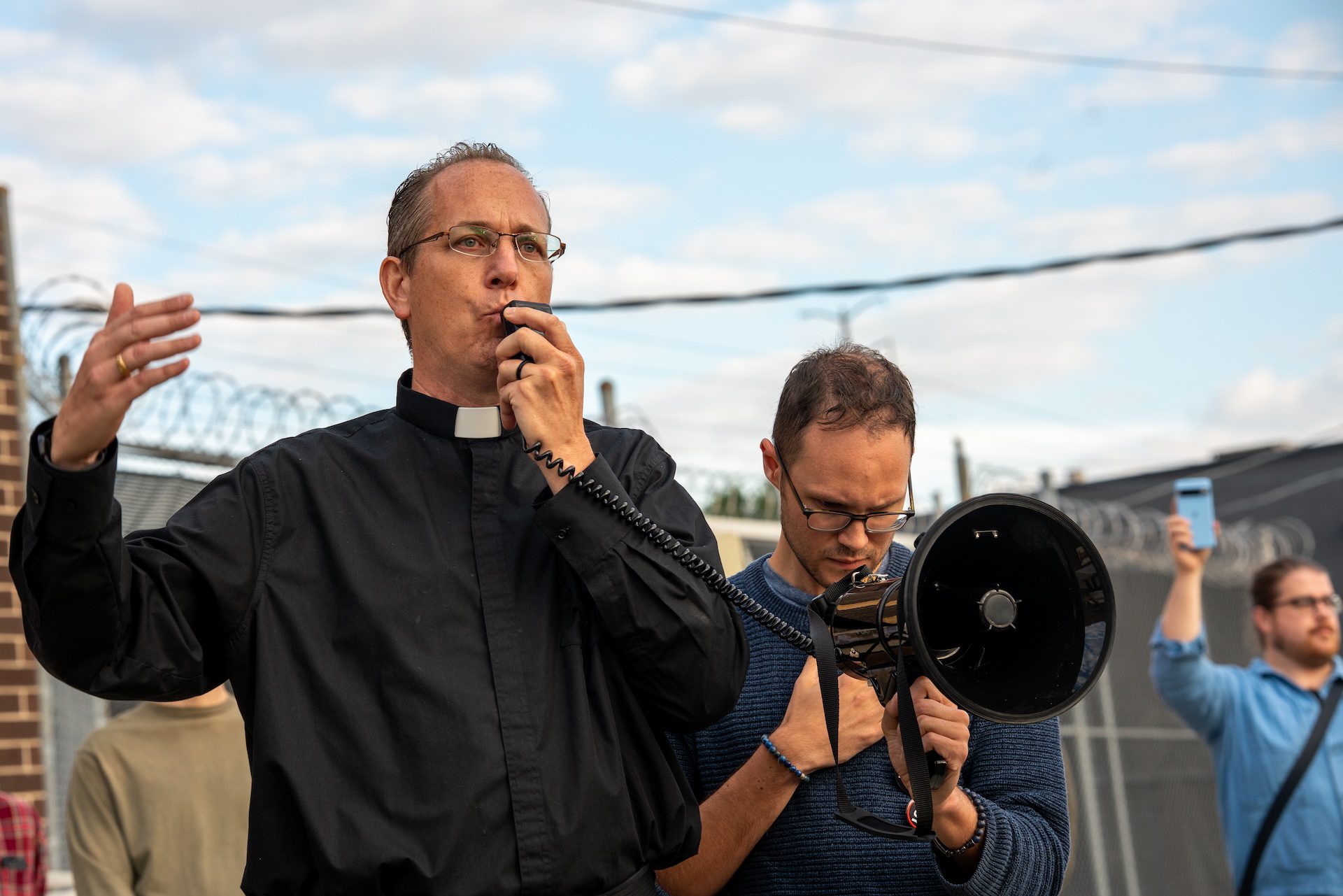
Chicago clergy took the mantle, launching sanctuary efforts for Central Americans fleeing wars in the 1980s. Now, the efforts continue with faith leaders on the frontlines at protests or providing for homebound immigrants terrified of being arrested by masked federal agents, or simply calling for humane support for others in a time of fear and chaos.
“We have to stand up for every person among us.”
Pastor Beth Brown embraced the legacy when she arrived in Chicago in 2013 from California at the Lincoln Park Presbyterian Church.
She found herself part of a church and religious community driven to do more for immigrants.
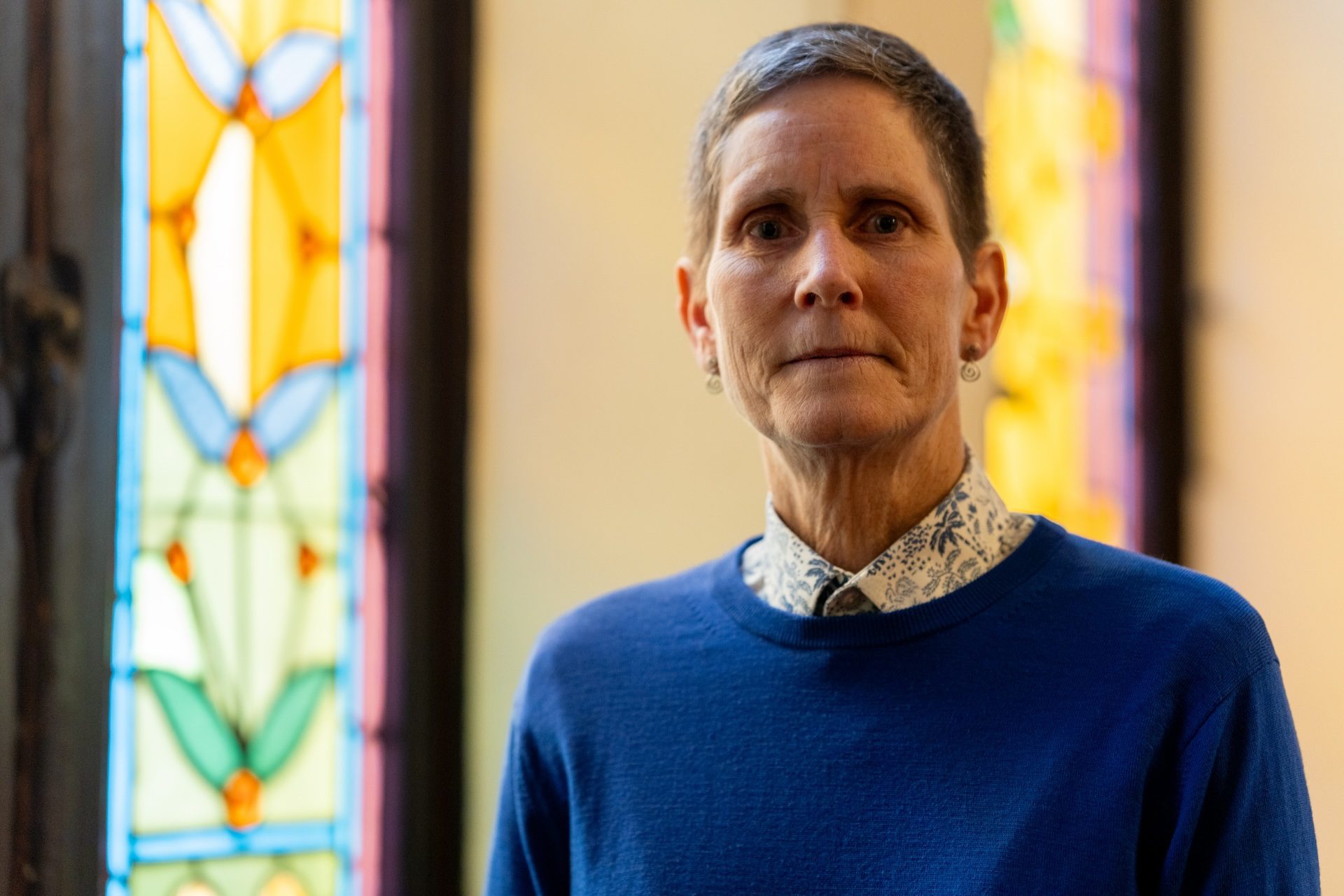
Her explanation for her commitment to advocating on behalf of immigrants is a message that resonates with fellow clergy.
“You could say the Hebrew Scriptures have many places where it talks about the importance of welcoming the stranger. I mean, all woven through, right? And if you look at Jesus’ life, it was all, sort of, opening one’s arms and especially to people who were cast out in any way,” she says.
But she pauses, mulls her words, and adds: “But somebody doesn’t have to be Christian. You could be an atheist and want to be compassionate and want people to thrive, no matter who they are, right? And if you are a Christian person, there is a mandate to this.”
Creating empathy for immigrants wasn’t hard when Pastor Beth arrived at the church, built in 1888 of Michigan buff sandstone.
Chicago clergy were among the leaders in the national effort to provide sanctuary to those fleeing wars and upheaval in Central America in the 1980s. Lincoln Park Presbyterian Church had a history of supporting causes such as the sanctuary movement.
Several decades later, clergy active in the sanctuary movement reached out to Pastor Beth in 2018, asking if her church would take in immigrants. The church was already using its basement to house the homeless, so it renovated its attic to accommodate one family in 2019 and a second in 2020.
A year later, 30 different groups created the Sanctuary Working Group to respond to dangerous conditions at detention facilities around the country for immigrants. Their work has since expanded to include finding short-term and long-term housing for immigrants, providing support to them, and accompanying them to court hearings.

Amid the arrival of immigrants in recent years, she felt that more needed to be done to house new arrivals and that Chicago’s religious community also had to step up its efforts.
In collaboration with other clergy, the Faith Community Initiative was established in 2023 with a $250,000 grant from the state. The goal was to house and support immigrants. Though the money expired after a year, the effort continues.
From helping immigrants find housing, the church’s work has shifted to workshops for immigrants on managing their finances or coping with the possibility of detention. It has reached out, and other churches have joined the effort. It regularly relies on neighbors and supporters to meet the requests of immigrants.
“Usually when we put out word that we need this or we need that, it gets filled pretty quickly,” she said.
At a Sunday afternoon church vigil recently, she spoke with passion to an audience of parishioners and clergy activists about urban violence and “state violence.”
“So, we have to stand up for every person among us,” she said. “We should remember what happened in Nazi Germany when too many people stayed quiet.”
‘Work of faith and action’
At his bare bones, second-floor office in an old Pilsen building, Father Brendan Curran’s day has been hectic: taking calls from community groups, planning for work with immigrants, linking up with other clergy and staying alert for the neighborhood ICE response team that he belongs to.
Father Curran, the son of an immigrant from Galway, Ireland, grew up “cradle Catholic.” He went to a parochial high school and a Catholic College. His time in a parish in Pilsen drew him more into wanting to serve the Latino community.
He now works for the Resurrection Project, a nonprofit organization created nearly four decades ago with small donations from six local parishes. Today, the nonprofit is one of the major supports for immigrants in the Latino community.
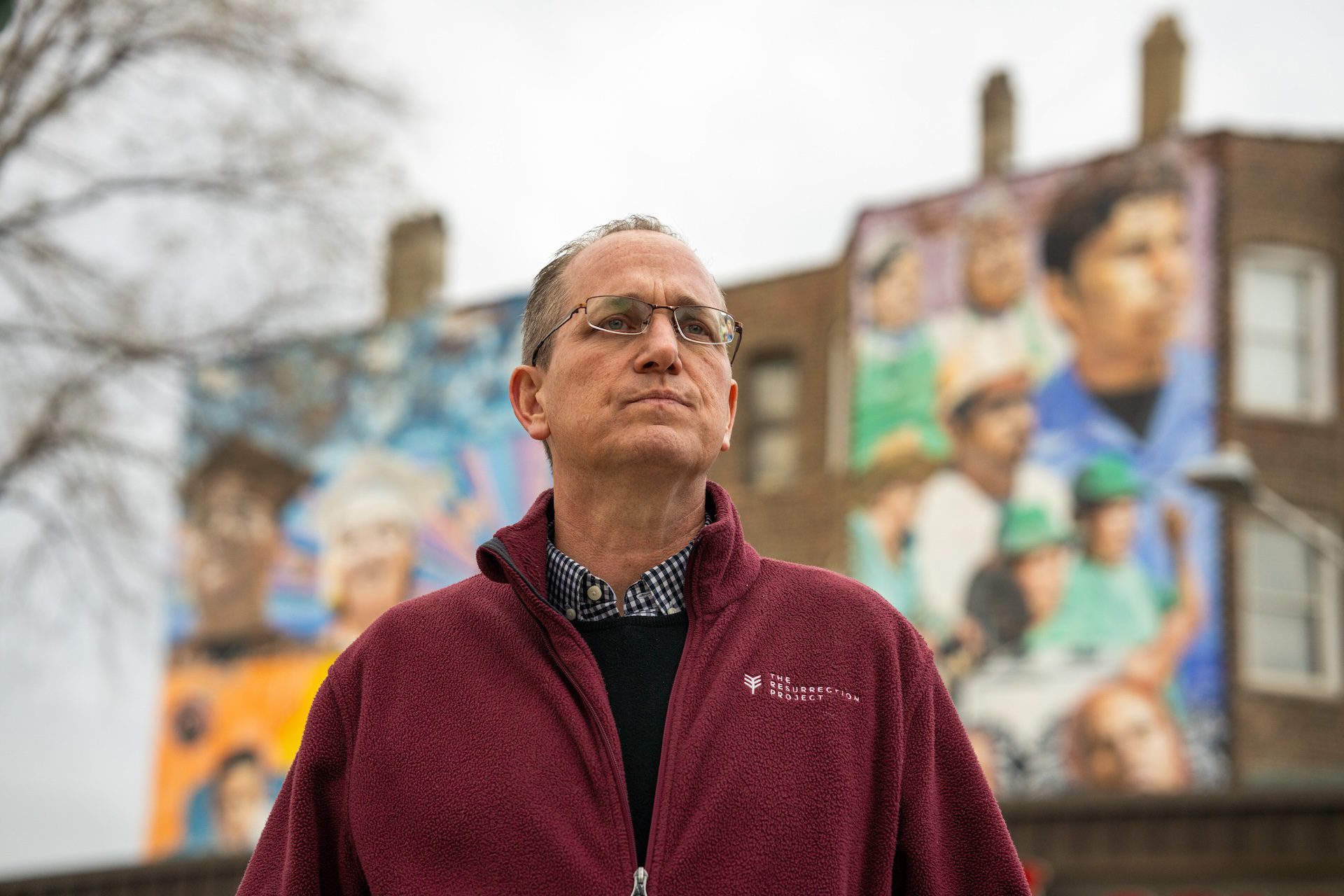
In his work, Father Curran sought to connect interfaith efforts by joining MedGlobal’s Humanitarian Faith Initiative, a local initiative that provides medical assistance in times of global crisis. He also worked to eliminate silos among clergy and helped create the Faith Table, an effort among neighborhood leaders of different faiths.
During the humanitarian crisis that began in 2022, he helped set up a word-of-mouth drive to house Central and South Americans being bused in from border states like Texas.
Word spread that people needed a place to stay, and that money was needed to house them. It has been something like an underground railroad, he says.
He has often found inspiration in Pope Francis’ advice that a pastor must be with his flock, his people and to do “work of faith and action.”
That work of faith and action, Father Curran says, is needed now more than ever.
‘We never take no for an answer.’
For Sister JoAnn and her long-term ally, Sister Pat Murphy, who had been a missionary in Peru, the challenges facing immigrants finding support, a place to live, or help overcoming the trauma they have endured continued to mount. Often, they were told that what they were doing had never been done before, let alone by two nuns.
And so, they developed words that have guided them over the years.
“Our motto is we do it peacefully and respectfully, but we never take no for an answer,” she said.
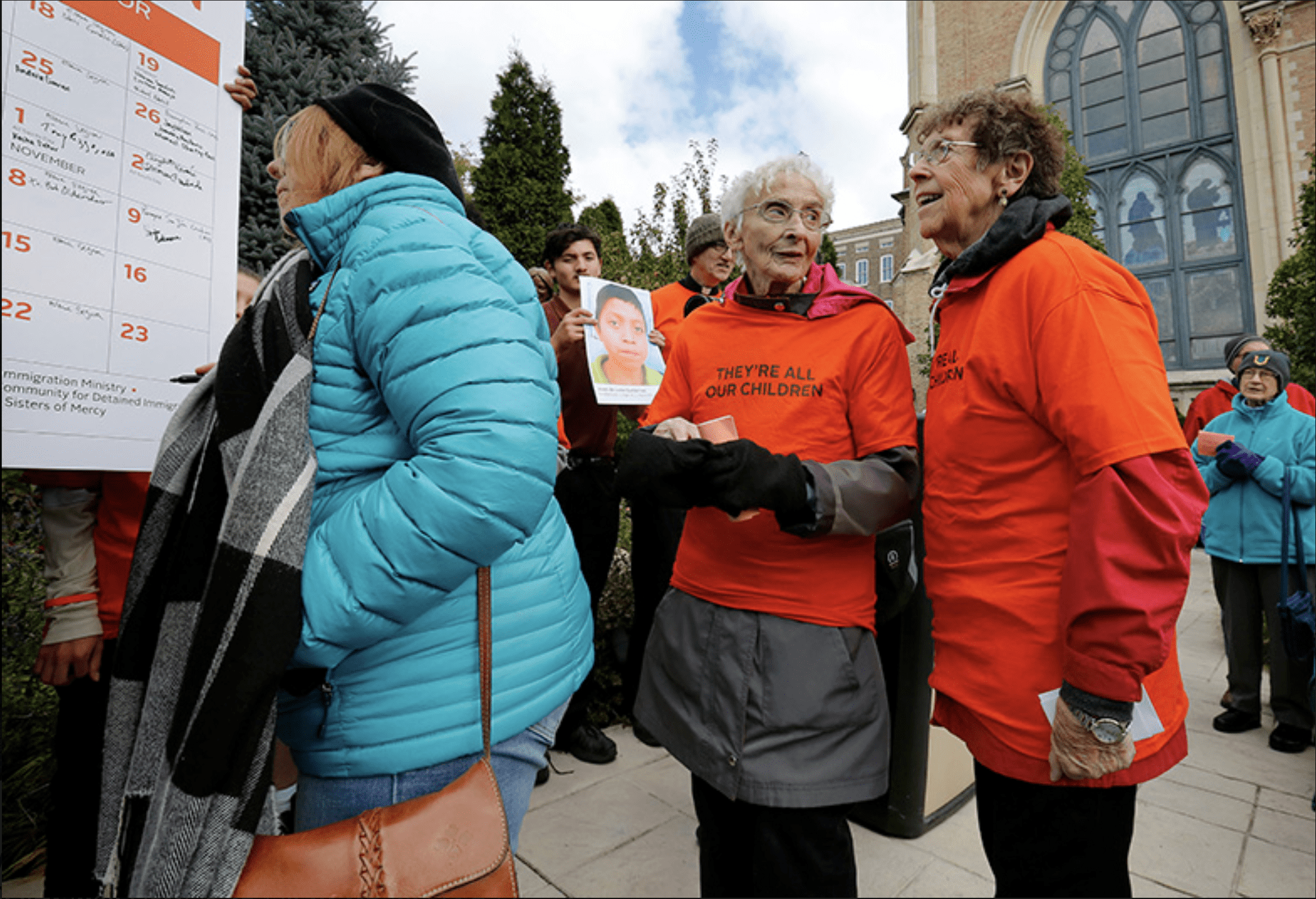
In 2006, they helped set up a Friday prayer vigil outside the Broadview Detention Center, where U.S. Immigration and Customs Enforcement (ICE) holds immigrants.
The prayer service that began on a cold Friday with only a few has since become a tradition and lately turned into a flashpoint between ICE and immigrant advocates.
Soon after their Friday prayer vigils, the nuns won the right to pray with immigrants at the detention center on the buses waiting to take them to the Gary Airport, where they would be flown out of the U.S. They wanted to pray inside local jails holding immigrants sent by Chicago Immigration Court. Despite initial resistance from officials, they ultimately won the right to do so.
For Sister JoAnn and Sister Pat, the prayer group was one effort in a long list of efforts to ensure faith leaders were doing as much as possible to impact vulnerable immigrants entangled in U.S. bureaucracies.
The nuns worked with the Kovler Center, one of the first trauma centers in the U.S. for immigrants, to set up Su Casa Catholic Worker House to house victims of torture from Central America. They also set up a court watch in Chicago’s Immigration Court and collaborated with an interfaith group to advocate on behalf of immigrants.
Most recently, the nuns created Catherine’s Caring Cause for the new arrivals at the height of the humanitarian crisis. It is named after Catherine McCauley, the founder of the Sisters of Mercy, a nun who established the order in Dublin, Ireland, in the 19th century.
Earlier this year, Sister Pat passed away at the age of 96.
After Sister Pat’s passing, Sister JoAnn carried on their work at the Mercy Meeting Place, located near St. Xavier University on Chicago’s far South Side. It was Chicago’s first Catholic higher education facility, created over a 100 years ago.
Delmis Cruz, a housekeeper at the Mercy Meeting Place, has a special bond with Sister JoAnn. Fleeing torture in El Salvador and Honduras, her family found a home years ago at the shelter the nuns were running for Central American torture victims.
As Delmis passed by in the hallway one day not too long ago, Sister JoAnn smiled at her and said she had often considered her a daughter.
Looking back over her life’s work, Sister JoAnn identifies with Pope Francis’ guidance to embrace and support immigrants. “That’s our philosophy. God’s children. Human Beings. They all need to be treated with dignity and respect,” she says.
But she was in a hurry that day, because there was a newly arrived immigrant family to be introduced to their new home. She apologized for her haste, saying she had work to do, quickly walked out to her car and zipped off.
As the prayers and protests outside the Broadview Detention Center became a symbol of Chicago’s support for immigrants in the last few months, clergy members decided to file a lawsuit to gain the right to pray with the detainees inside the facility.
They asked Sister JoAnn, due to her decades of dedication in supporting immigrants, to be the first to sign the lawsuit.
She did on Nov. 14 and then died a few hours later. She was 91.
Stephen Franklin is a contributing writer for Borderless Magazine.